Where to Buy Jewellery: Every Channel Compared for Safe, Smart Buying
Where to buy jewellery depends on what you are buying, how much proof you need and how much service you expect after the sale. Online brands and marketplaces win on price and choice, independent jewellers win on advice and repairs, chains win on convenience and warranty, and auctions or bespoke workshops win on uniqueness. In practice most buyers now use two channels at once: research and shortlist online, then inspect, collect or return in person. This guide compares every realistic place to buy jewellery, shows you how to check a seller before you pay, and explains why the box your jewellery arrives in is part of the purchase, not an afterthought.
By Packaging Editorial Studio · 9 min read · Updated September 2026
The Short Answer
If you want the honest answer to "where to buy jewellery", start from the piece, not the shop. A pair of everyday gold hoops is a completely different purchase from a certified one-carat solitaire or a restored Art Deco brooch. Use this simple rule:
- Under roughly $300 and mostly about style? Buy from online brands or marketplaces. Price competition is brutal, returns are easy, and the setting is rarely the expensive part.
- Certified stones, engagement rings, anything above four figures? Buy where you get a lab report, a written specification, a return window and after-sales resizing.
- Antique, one-off or sentimental pieces? Auction houses, estate sellers and bespoke workshops, always with an independent appraisal before money moves.
Whichever channel you choose, the decision is really about proof. A good seller can tell you the metal purity, the stone grade, the treatment history and the return terms in writing. A bad one can only send you more photos.
The Six Realistic Places to Buy Jewellery
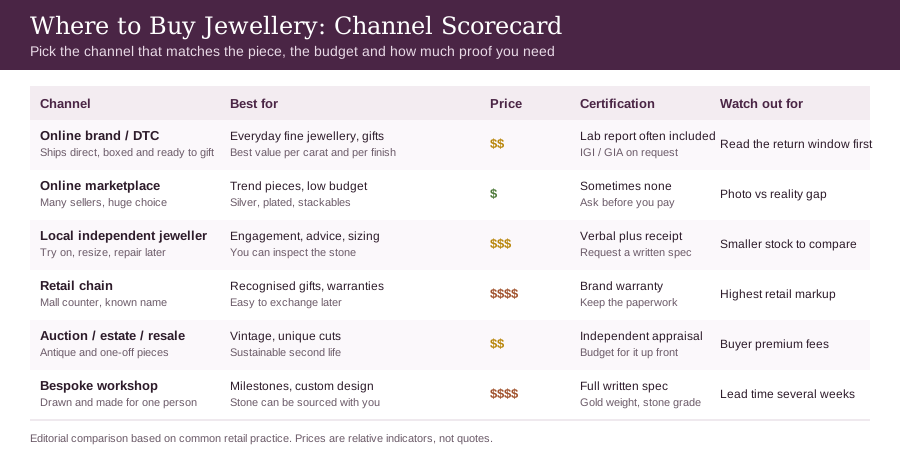
Every jewellery purchase routes through one of six channel types. They differ on price, proof and risk, and the differences matter more than any single brand name.
1. Online brand and direct-to-consumer stores
A brand's own website is usually the best value for fine gold and lab-grown diamond pieces. There is no retail markup from a physical store, the full specification is listed in text you can save, and the item ships already gift-boxed with its documentation. Look for a published return window of 14 to 30 days, a lab report number you can verify online at the issuing laboratory, and clear hallmarks photographed alongside a ruler for scale.
2. Online marketplaces
Marketplaces carry almost everything, from $20 silver to five-figure stones listed by hundreds of sellers. That breadth is the benefit and the risk. Filter for sellers who show the hallmark stamped on the metal rather than a model shot, who list stone treatments honestly, and who accept returns rather than "exchange within 48 hours". Treat any listing without a clearly photographed clasp and hallmark as ungraded costume jewellery priced accordingly.
3. Local independent jewellers
This is where advice, sizing and repair actually happen. An independent can check your existing pieces, resize on the spot, source a specific stone and hand you paperwork tied to a real address. You pay more, but the ongoing relationship - cleaning, re-tipping prongs, checking settings each year - is worth real money over the life of a piece.
4. Retail chains and department counters
Chains sell convenience, recognised branding and uncomplicated warranties, which is why they dominate gift buying. Prices carry the cost of the display cases and the mall lease. If you buy here, keep every document: the warranty is usually only redeemable with proof of purchase, and the original box often forms part of resale value later.
5. Auctions, estate sales and resale platforms
The best place to find a cut, a maker or a period piece nobody is manufacturing any more, and often the most sustainable purchase you can make. Two cautions: budgets must include the buyer's premium and any import duty, and condition descriptions should be backed by an independent appraisal before payment. Resale platforms sit between auction and retail, usually with authentication built into the checkout.
6. Bespoke workshops
When the piece has to be a specific design - a re-set heirloom stone, a wedding set matched to an engagement ring - go bespoke. Agree everything in writing first: gold weight and purity, stone grade and treatment, expected lead time, number of revision rounds and who pays for remakes. Bespoke is the slowest channel and the least price-competitive, but it produces exactly one thing: your piece.
The Numbers Behind Where People Buy Jewellery Now
The market data explains why "where to buy jewellery" is no longer a question with a single answer. Compiled industry figures for 2026 show the global jewellery market reached roughly $242.8 billion in 2025, while online jewellery sales now account for about 25% of the global total and are growing at an estimated 11 to 13% per year - two to three times the growth rate of the category overall. Offline retail still generates about 83.9% of global jewellery revenue, so the store is not disappearing; it is simply no longer the first step.
The behavioural detail is more useful than the market size:
- 73% of jewellery purchases begin on a smartphone. Discovery is mobile first even when collection happens in person.
- The average engagement ring buyer visits about five jewellers before purchasing, and around 54% spend one to four months deciding. Comparison shopping is now the default, not the exception.
- 67% of shoppers use social media for jewellery or fashion inspiration, and more than half of Gen Z has ordered directly through a social platform.
- AR and 3D product views lift conversion by up to 94% versus static images, and retailers using virtual try-on report roughly 40% fewer returns on high-value items.
Read together, these numbers describe a loop rather than a straight line: see it on social or mobile, shortlist online, touch it in person if the value justifies it, then buy from whichever channel gave you the cleanest proof and the best terms.
Seven Checks Before You Pay, Whatever Channel You Choose
- Get the metal in writing. "9kt" or "14kt", gold purity stamped on the piece, or 925 for sterling silver. Gold-plated and gold-filled must say so explicitly.
- Ask for the lab report number on any stone over roughly half a carat, and verify it on the issuing laboratory's own site. GIA and IGI are both checkable online.
- Ask about treatments. Heat-treated, fracture-filled and diffusion-treated stones are legitimate but must be disclosed, because they change the price significantly.
- Confirm the return window and who pays return shipping. A 7-day exchange-only policy is a red flag on a four-figure purchase.
- Check the measurement photos. Ask the seller to photograph the piece next to a ruler or on a finger. Scale is the most common cause of disappointment online.
- Use protected payment. Card or a platform with buyer protection, never a direct bank transfer to an individual.
- Ask what it ships in. A ring travelling loose in a pouch can arrive with a bent shank or a scratched setting. Proper retail packaging is protective, not decorative.
The Documents Worth Keeping Forever
Jewellery has a secondary life, and paperwork determines what it is worth. Keep the purchase invoice, the laboratory certificate, any insurance valuation, service and repair receipts, and the original manufacturer documentation. On the secondary market, these papers routinely separate a quick sale at a fair price from a slow sale at a discounted one - exactly the same pattern you see in watches, where a complete set with box and papers sells for measurably more than the item alone.
The Box Question: What Your Jewellery Arrives In Matters
People rarely buy jewellery for themselves in a bare envelope. It is given, proposed with, worn at a wedding and eventually insured, so the container has to survive three separate jobs: shipping protection, presentation, and long-term storage. A good jewellery box does all three. Structurally it stops chains knotting and settings grinding, chemically it limits the air and moisture that cause tarnish, and visually it turns "I bought a thing" into "I chose this for you".
That is why the box should be a purchase criterion, not an assumption. When comparing sellers, ask three questions: does the piece ship in a rigid or structured box rather than a pouch, does it come with an insert that holds the item still in transit, and can you buy replacement or additional boxes later?
For anyone building a small brand, selling on marketplaces, or simply replacing the tired boxes your own collection lives in, buying boxes online has become the practical route. Retail-ready jewellery boxes can be ordered directly from specialist manufacturers without waiting for a bespoke production run. Karipackage supplies jewellery boxes for online retail purchase alongside its custom manufacturing service, so a small seller can buy a ready-made ring, pendant or necklace box in small quantities today and move to a fully branded version once volume justifies tooling. With 30 years of colour box manufacturing behind it, Karipackage builds both options from the same materials and quality controls - rigid wrapped board, velvet or flocked inserts, magnetic or lift-off closures - which means the first box you sell in and the ten-thousandth look like the same brand.
Checklist: Choosing Where to Buy
- Decide whether this purchase is about style, certificate value or uniqueness
- Shortlist two sellers per channel, not one, and compare written specifications line by line
- Verify any lab certificate number on the issuing laboratory's website
- Confirm the return policy and return shipping cost before checkout
- Check hallmark photos on metal pieces and scale photos on everything
- Ask what the item ships in and whether a replacement box can be bought later
- File invoice, certificate and photographs the day it arrives
FAQ: Where to Buy Jewellery
Where is the best place to buy jewellery online?
For everyday fine jewellery, a brand's own website offers the best balance of specification transparency, return policy and price. For anything with a certified stone, buy from a seller that publishes the lab report number and allows returns rather than exchange-only credit.
Is it safe to buy expensive jewellery online?
Yes, provided you insist on four things: a verifiable certificate, a written return window, protected payment, and insured shipping with signature on delivery. Screenshot the listing and keep all correspondence.
Is it cheaper to buy jewellery online or in a shop?
Online is usually cheaper for comparable specification, because there is no showroom overhead. Independent shops add advice, sizing and repair, which is real value but priced into the ticket. Shops remain the stronger choice when fit, feel and after-care matter more than unit price.
Where should I avoid buying jewellery?
Avoid any seller that cannot state metal purity, will not describe treatments, refuses returns, or pressures you into an irreversible payment method. Listings that only ever show catalogue renders rather than the actual piece are the clearest warning sign.
What paperwork should jewellery come with?
An itemised invoice listing metal and stone specifications, a laboratory certificate for significant stones, care instructions, and - for higher-value purchases - an insurance valuation. All four should be kept together with photographs.
Do I need a proper jewellery box as well?
Yes. Storage is the cheapest insurance on jewellery: separated compartments prevent scratches and tangles, and a closed box slows the tarnish that dulls silver and plating. It also protects resale condition and value.
Source Your Jewellery Boxes With Karipackage
Once you have decided where to buy the jewellery itself, decide what it will travel and live in. Start with the pieces to be held, choose the insert layout that keeps them still, and match the outer finish to the brand or occasion.
Karipackage is a professional colour box and carton supplier with 30 years of manufacturing experience, and it also supplies jewellery boxes for online retail purchase. Small-batch sellers can order stock boxes immediately with no tooling commitment, then move to fully custom sizes, wraps and foil finishes as the range grows. Browse retail jewellery boxes or request a custom quote from Karipackage.
Sources and Editorial Notes
Consumer and market figures compiled from Jewel360, 35 Online Jewelry Sales Statistics, 2026; Teal Packaging, 2026 Custom Packaging and Ecommerce Packaging Statistics; and United States Census Bureau e-commerce data cited therein. Prices, premiums and availability vary by market and season. Always verify certificates with the issuing laboratory and confirm return terms with the seller before purchase.
Leave a Comment
Comments are reviewed before appearing.